
FREE SPI PRACTICE TEST (CAN YOU PASS THE 2026 SPI?)
15 QUESTIONS - 5 MINUTES - INSTANT SCORE
Now that you’ve completed the practice test, you should have a better sense of where you stand. You might have noticed a few areas that felt easy and a few that need more attention.
In the sections below, we’ll walk through what the SPI exam involves, what topics matter most, and how you can prepare more effectively moving forward.
What Is the SPI Exam?
The SPI (Sonography Principles and Instrumentation) exam is administered by ARDMS, the American Registry for Diagnostic Medical Sonography. It tests your foundational knowledge of ultrasound physics and instrumentation.
It covers topics such as image optimization, transducer management, and Doppler imaging principles.
The exam meets the fundamental physical principles and instrumentation requirements for the RDMS, RDCS, RVT, and RMSKS credentials.
The exam is computer-based and 2 hours timed. It consists of 110 multiple-choice questions that test your grasp of ultrasound theory alongside your ability to apply it in real clinical situations.
Let’s see more briefly about it.
SPI Exam Quick Facts
Detail | Standard |
Number of Questions | 110 multiple-choice |
Time Allowed | 2 hours |
Passing Score (Scaled) | 555 out of 700 |
Exam Format | Computer-based |
Administered By | ARDMS via Pearson VUE |
Score Report | Same day (in-person); within 1 hour (online) |
Retake Waiting Period | 60 days |
Exam Fee | $250 USD |
Requirements for the SPI Exam
The Sonography Principles and Instrumentation (SPI) Exam is a critical step for anyone pursuing an ARDMS credential. To sit for the exam, you must have completed any of the following:
- A college-level or post-secondary physics course (grade C or higher)
- An approved ultrasound physics review seminar is worth at least 12 ARDMS-approved CME credits.
With any one of these transcripts or certificates in hand, you’re ready to take the next step.
What the SPI Exam Covers
The SPI exam is divided into five domains. Understanding how much each domain weighs on the exam tells you exactly where to put your study energy.
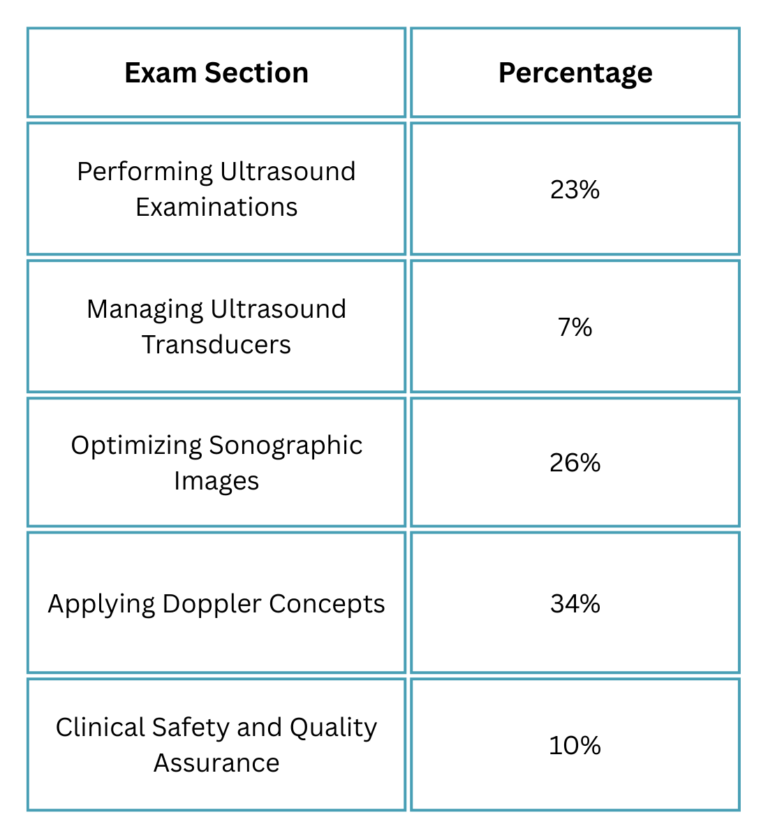
The biggest takeaway here: Doppler Concepts alone is 34% of your exam. If you’re short on study time, start there.
Below is the detailed explanation of each section.
Performing Ultrasound Examinations (23%)
This section bridges theory and practice. Keep focus on the following:
- Standard scanning protocols and how to deviate from them when needed
- Common imaging artifacts, what causes them, and how to correct for them
- Patient care standards, including positioning, privacy, ergonomics, and contrast agent use
- Tissue density, penetration limits, and when to switch transducers
What does it test? Patient history review, imaging artifacts, established protocols, ergonomics, and patient care standards.
Managing Ultrasound Transducers (7%)
The lightest domain, but foundational. Know:
- The piezoelectric effect, how electrical energy converts to sound and back
- Matching layer, backing material, and acoustic lens: what each component does
- How frequency selection affects resolution and depth
- Linear, curvilinear, phased array, and annular array transducers, and their use cases
What does it test? Transducer types, components, and frequency relationships.
Optimizing Sonographic Images (26%)
This domain is about understanding your machine controls and why each one does what it does. Study:
- Time Gain Compensation (TGC) and how it evens out depth-related signal loss
- How PRF, PRP, and pulse duration relate to image quality
- Frame rate, sector width, and their trade-offs
- Pre-processing vs. post-processing: what can and can’t be changed after acquisition
What does it test? PRF, PRP, pulse duration, sector width, scan lines, frame rate, pre/post-processing.
Applying Doppler Concepts (34%)
This is the heaviest section on the exam. You need to understand the Doppler effect well beyond just the definition. Focus on:
- Doppler shift and how the angle of insonation affects it
- The Nyquist limit and why aliasing happens
- Continuous wave vs. pulsed wave Doppler
- Color Doppler, power Doppler, and spectral Doppler: the differences and when each is used
- Hemodynamic principles and how vessel resistance affects your waveforms
- Wall filter settings and how gain impacts your reading
What does it test? Doppler shift, angle correction, color flow, hemodynamic principles, aliasing, artifacts.
Clinical Safety & Quality Assurance (10%)
Small weight, but don’t ignore it. These questions are often straightforward and very winnable with focused prep. Cover:
- ALARA principle and why it guides every exam
- Mechanical Index (MI) and Thermal Index (TI), what they measure, and safe thresholds
- Equipment quality assurance protocols
- CDC infection control guidelines for transducer handling and disinfection
What does it test? CDC guidelines, infection control, equipment safety, and bioeffects.
How to Register for the SPI Exam
The registration process has a few clear steps. Here’s exactly what to do:
Step 1: Create your ARDMS account.
Go to the ARDMS website and create a free account through the MY ARDMS portal.
Step 2: Submit your application.
Select the “SPI Examination Requirement” pathway.
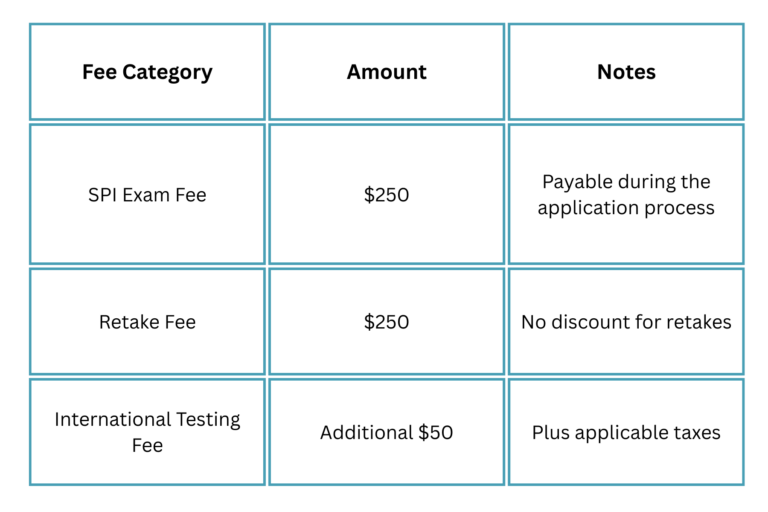
Complete the online application, upload your eligibility documentation (transcript or CME certificate), and pay the $250 exam fee.
You have 21 days from account creation to submit your application.
Step 3: Wait for your Examination Confirmation Letter (ECL).
ARDMS typically reviews applications within 10 days. You’ll receive either an ECL confirming approval or a request for more information.
If found ineligible, you get a partial refund minus a $100 processing fee.
Step 4: Schedule your exam through Pearson VUE.
Once you have your ECL, you have 90 days to schedule and take your exam.
You can choose between an in-person testing center or online proctored testing (OnVUE).
Note on International Test Centers: An additional non-refundable fee of $50 applies for locations outside the US, Canada, and Mexico. |
Tips to Prepare for the SPI Exam
These aren’t generic study tips. These are the habits that directly move your score.
- Start with Doppler, it’s 34% of your exam. As already said, Doppler makes up a major part of the exam, yet many students spend too much time on transducer basics. Focus on Doppler first, then build out the rest.
- Analyze every practice test. Don’t just check the correct answer. Review every mistake and ask why you got it wrong. That will show you exactly what to study next.
- Study by domain, not by topic. Learn each domain well, then practice with mixed-question sets. This helps you get used to the way the real exam shifts between topics.
- Time yourself before test day. Take at least two full-length timed tests before exam day. 110 questions in 2 hours is about 65 seconds per question. It’s a manageable pace, but only if you’ve trained for it.
- Use one solid study resource consistently. Switching between too many study guides can make your prep feel scattered. One structured resource is usually the better approach.
- Understand concepts, not just questions. The exam will not repeat practice questions word for word. If you understand the concept behind the question, you’ll be able to answer it in any form.
How Medical Hero Helps You Pass
A good study plan is important, but having the right resource can make it much easier to stay consistent.
That’s where Medical Hero helps, with focused study tools built around the topics that matter most for the SPI exam.
What you get:
- Expert-built study materials focused on exam-relevant topics
- Up-to-date content aligned with current exam standards
- Practice questions and simulated tests to apply concepts
- Clear explanations to help you understand mistakes
- Money-back guarantee for added confidence
Instead of switching between multiple resources, you get a more streamlined way to prepare and track your progress.
Frequently Asked Questions about the SPI Exam
The pass rate for the SPI exam in 2023 was 61% overall. First-time test takers had a higher pass rate of 71%, while repeat test takers had a pass rate of 49%. This underscores the importance of thorough preparation.
Your application will automatically be approved, and you will be able to schedule within a day. You must wait 60 days before you can retake the SPI examination if you do not pass it however, you are welcome to reapply after 3 days.
Yes, the SPI exam involves math related to ultrasound physics, such as calculations for frequency, pulse repetition, and other measurement concepts.
The math is generally at a basic to moderate level, similar to high school physics, and is integrated into the exam’s practical application questions.
The SPI Program is a three-day (27-hour) training course and a separate two-day (16-hour) assessment. Certification lasts for three years as long as the candidate keeps current AMGA Membership and First Aid Certification.
Our Student's Said
Breeze through your SPI written exam
Don’t risk failure: use SPI Hero to pass first time!
