
FREE CNA PRACTICE TEST: PREPARE FOR YOUR CERTIFIED NURSING ASSISTANT EXAM
Test your CNA knowledge with realistic practice questions covering patient care, infection control, safety procedures, communication, and essential nursing assistant skills.
"*" indicates required fields
What is the CNA Exam?
The Certified Nursing Assistant (CNA) exam is a certification assessment that evaluates candidates’ knowledge and hands-on skills required to provide safe patient care in healthcare facilities.
The exam usually includes two sections:
- Written/oral knowledge test: Evaluates understanding of CNA responsibilities, safety, infection control, resident rights, and basic nursing care.
- Skills demonstration test: Evaluates your ability to perform essential CNA procedures correctly under observation.
Passing the CNA exam allows candidates to become listed on their state’s Nurse Aide Registry and begin working as certified nursing assistants.
Who Administers the CNA Exam?
The CNA exam is administered by approved testing organizations that vary by state. Common providers include:
- Prometric
- Pearson VUE
- Headmaster/D&S Diversified Technologies
Candidates should check their state’s Nurse Aide Registry or training provider for specific testing requirements.
CNA Exam Overview
To successfully pass the CNA exam, it’s important to understand its two components:
Written/Oral Test
This section evaluates your theoretical understanding of CNA responsibilities. You’ll answer 70 multiple-choice questions, categorized into three areas:
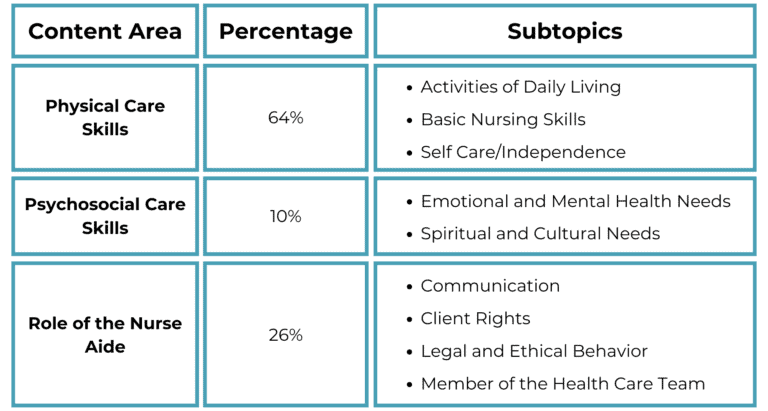
Candidates can choose the oral test if they’re more comfortable with an audio-based format.
Skills Demonstration Test
The practical test assesses your ability to perform CNA skills under observation. Five randomly assigned skills include:
- Mandatory Skill: Hand hygiene (proper handwashing).
- Common Skills: Transferring patients, assisting with feeding, catheter care, measuring vital signs, and patient positioning.
- Additional Skills Often Tested:
- Additional Skills Often Tested:
- Range of Motion (ROM) Exercises: Helping patients maintain or improve mobility.
- Making an Occupied Bed: Changing linens while the patient is still in the bed.
- Ambulation Assistance: Helping a patient walk, often using a gait belt.
- Measuring Output: Recording the amount of urine or fluid output.
- Emergency Skills: Responding to emergencies like CPR or first aid.
- Communication Skills: Interacting with patients to explain procedures, ensure comfort, and maintain professionalism.
- Safety and Infection Control: Following safety protocols, wearing gloves, and using equipment properly.
CNA Exam Registration Process
Examiners assess accuracy, safety, patient communication, and infection control practices to ensure you’re ready for real-world CNA duties.

CNA Exam Scoring Mechanisms
The CNA exam has separate passing requirements for the written and skills sections. Candidates must demonstrate both knowledge and practical ability to pass.
The exact passing score varies by state, so candidates should check their state testing requirements.
General Scoring Overview
- Both the written/oral and skills demonstration tests have specific passing criteria set by state regulations.
- Written tests typically require candidates to achieve a minimum percentage score (commonly 80%).
- Practical tests are evaluated using a standardized checklist of tasks, focusing on safety, accuracy, and communication.
Important Considerations
- Critical steps in each skill must be performed correctly to pass. Missing these steps can significantly impact scores.
- Candidates receive a score report that highlights their performance, making it easier to identify areas needing improvement.
- Many states allow candidates to retake only the section they failed.
What Happens if You Don’t Pass?
- Candidates who fail one or both sections can retake only the failed portion. Most states allow three attempts within a certain timeframe.
- Detailed feedback is provided to help candidates identify areas for improvement.
Tips for Success
- Pay attention to time management during the test, especially for the practical skills section.
- Focus on mastering critical steps for each skill, as these are essential for passing.
- Use score reports to adjust your study plan and retake the exam with confidence.
Essential Resources for CNA Exam Preparation
To succeed in the CNA exam, it’s necessary to use effective preparation tools that cater to diverse learning styles. Below is a list of recommended resources, their descriptions, and how they can support your exam readiness:

These resources are designed to help you prepare effectively for the CNA exam. Whether it’s using flashcards for quick reviews, watching video tutorials to master skills, or taking practice tests to simulate the real exam, these tools will support your learning and boost your confidence as you get ready to succeed.
Start Practicing for Your CNA Exam Today
Preparing for the CNA exam requires understanding both theory and practical skills. Use this free CNA practice test to evaluate your readiness, review important concepts, and build confidence before exam day.
Our Happy Students
Further Questions on the CNA Exam
The CNA exam is a certification test for individuals aspiring to become Certified Nursing Assistants. It comprises two parts: a written or oral multiple-choice test and a hands-on skills demonstration to assess knowledge and practical abilities in patient care.
The cost varies by state but typically ranges from $80 to $100 for both the written/oral and skills demonstration tests.
CNA exams are offered throughout the year at designated testing centers or online (depending on your state). Consult your training provider or the official state guidelines to find testing dates and locations near you.
To be eligible, you must complete a state-approved CNA training program, which includes classroom instruction and hands-on clinical experience. Additional requirements, such as age and background checks, vary by state.
The time to complete a CNA training program and certification typically ranges between 6 to 12 weeks, depending on the program and state requirements.
CNA licenses are typically valid for 24 months. In most states, you must work at least eight hours during this period to maintain active certification. If this condition is not met, you may need to retake the competency exam.
As of recent data, the median hourly wage for CNAs is approximately $14.82, though this can vary depending on experience, location, and the healthcare facility.
CNAs assist with basic patient care, including:
- Monitoring vital signs.
- Helping with mobility and hygiene.
- Assisting with meals.
- Communicating patient needs to the healthcare team.
CNAs generally work 32 to 40 hours per week for full-time positions, with schedules varying based on the facility’s needs.
To pass the CNA exam, study key concepts, practice critical skills, and take timed practice tests. Focus on weak areas, understand critical steps in skills, and stay calm during the test.
There’s only one thing standing between you and an exciting career as a certified nursing assistant: your CNA exam!
We use actual questions that appear on the written portion of the CNA exam, so our practice test will help you discover if you’re definitely prepared for the real thing!
The CNA exam is divided into two parts:
- The written exam contains 60 multiple-choice questions and is usually about two hours long.
- The clinical skills test requires you to perform certain nursing tasks in front of an evaluator, and usually lasts about 45 minutes.
Our free practice test (below) helps you prepare for and pass the written portion of the exam: it contains 20 questions, all of which are representative of the questions that appear on the real thing.
Breeze through your CNA written exam
Don’t risk failure: use CNA Hero to pass first time!
