

So you’ve got your Certified Nursing Assistant (CNA) license in the U.S., now you’re ready to level up.
Whether it’s higher pay, a specialty you care about, or standing out with employers, specialty certifications can help you get there.
Lucky for you, we’ve pulled together the top 5 specialty certification options for CNAs available in the U.S. and how each one can shape your career path.
The Benefits of Specialty Certifications for CNAs
It is essential for a CNA to earn extra certifications in the nursing industry. Extra certifications are helpful in advancing in your career as a Certified Nursing Assistant (CNA).
Earning one or more specialty certifications relevant to your industry benefits you and adds more value to your career as well.
Some of the benefits of earning specialty certifications are as follows:
- It helps you gain recognition among your team members.
- It can help you reach higher positions with the required qualifications, skills, and experience.
- It broadens your professional opportunities as a CNA in the healthcare industry.
- Helps boost improve your level of confidence.
Now that you are aware of how specialty certifications can benefit you, let’s discuss some of the specialty certification options available for CNAs in the U.S.
5 Specialty Certifications for CNAs
Specialty certifications add more value to your career. It also helps you gain more knowledge and understanding of many things in the nursing industry.
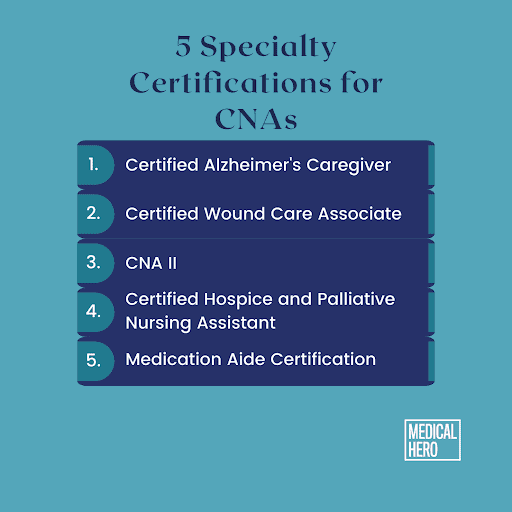
Here are some specialty certifications for CNAs:
- Certified Alzheimer’s Caregiver.
- Certified Wound Care Associate.
- CNA II.
- Certified Hospice and Palliative Nursing Assistant.
- Medication Aide Certification.
Let’s dive into these specialty certifications in more detail.
CERTIFIED ALZHEIMER CAREGIVER
Certified Alzheimer’s Caregiver is a certification program undertaken by people who care for patients with Alzheimer’s disease and Dementia. This course can be undertaken by a candidate as a family member, a Certified Nursing Assistant (CNA), or an individual working in adult daycare centers or nursing homes.
A Certified Alzheimer’s Caregiver has an in-depth understanding and knowledge of the special requirements and circumstances of patients with Alzheimer’s and Dementia, and their families. They are well-equipped to work on a practical level and can apply the right strategies to offer the best care possible for such patients.
How to Apply:
- Enroll through organizations like the National Council of Certified Dementia Practitioners (NCCDP) or other accredited dementia-care programs.
- Requirements vary, but CNAs typically need to complete a short training course and pass an exam.
- Some programs are online; others require in-person training.
CERTIFIED WOUND CARE ASSOCIATE
A Certified Wound Care Associate (CWCA) is a certification program offered for CNAs who are interested in wound care. The CNAs who are Certified Wound Care Associates have in-depth knowledge of wound management.
This certification program helps to promote the quality of care offered to patients with wounds. By providing high-quality patient care, the professional is skilled in handling wounds.
How to Apply:
- Offered through the American Board of Wound Management (ABWM).
- Applicants usually need healthcare experience (CNA eligibility is accepted in many states).
- Complete coursework and sit for the CWCA certification exam.
CNA II
The CNA II program is a training program that broadens and enhances the scope of practice for CNAs in the U.S. This program helps students equip themselves with several skills apart from basic CNA skills.
CNAs are trained to take care of patients with chronic and stable conditions in the CNA II training program. CNAs who have completed the CNA II training program must still work under the supervision of a registered nurse.
How to Apply:
- Apply through your state-approved CNA II training program (community colleges, technical schools, or healthcare facilities).
- You must already hold an active CNA license.
- Complete classroom and clinical hours, then pass the state CNA II exam.
CERTIFIED HOSPICE AND PALLIATIVE NURSING ASSISTANT
The Certified Hospice and Palliative Nursing Assistant is a certification program offered to CNAs who wish to become Hospice CNAs.
These CNAs offer a variety of services to hospice patients and their families. Hospice CNAs generally work under the supervision of a registered nurse or a physician.
How to Apply:
- Offered through the Hospice and Palliative Credentialing Center (HPCC).
- Eligibility: active CNA license + experience in hospice/palliative care.
- Apply online, complete the training, and pass the certification exam.
MEDICATION AIDE CERTIFICATION
A Medication Aide Certification is a type of training program offered for Certified Nursing Assistants (CNAs). The CNAs are trained to dispense medications to patients in hospitals and other healthcare facilities.
A Certified Medication Aide (CMA) can also perform CNA duties on patients. CMA is an entry-level role in the nursing industry. You can also build a long-term career in the healthcare industry by starting your career as a Certified Medication Aide (CMA).
How to Apply:
- Apply through your state board of nursing or approved training program (requirements vary).
- Must hold an active CNA license and have a set number of work hours as a CNA (requirements differ by state).
- Complete the state-approved training and pass the Medication Aide exam.
Now that you have an idea of some of the specialty certifications for CNAs, are you wondering how to list your certifications on your resume?
Worry not! We have got that covered too.
How to List Your CNA Certifications?
After the completion of your certification, it is essential for CNAs to include all their certifications as part of their professional title.
The American Nurses Association (ANA) has set an order to list any designations you have earned as a Certified Nursing Assistant (CNA) in the U.S.
The order preferred by the ANA is as follows:
- Highest degree earned.
- Licensure.
- State designations or requirements.
- National certification.
- Other recognitions.
Wrapping Up
As a practicing CNA, it is essential to keep learning to equip your knowledge and skills to stand out among your coworkers. Gaining extra certifications in the industry benefits you and adds more value to your resume. Apart from gaining the certification, it is equally as important to list them in the right order to help you quickly land a good job in the healthcare industry.
If you have been considering taking the CNA exam or know someone who is planning to take it, make sure to refer to our free CNA practice test to help you with the preparation process.
Frequently Asked Questions (FAQs)
If you have been dreaming about becoming a traveling CNA but are wondering how to become one, here are some of the steps you should take to become a traveling CNA:
- Earn a high school diploma or GED.
- Complete a Certified Nursing Assistant (CNA) training program from a state-recognized academy.
- Earn a CNA license or certification.
- Hold a CPR certification.
- Gain some experience in hospice care for at least 6 months.
- Hold a valid driver’s license and have reliable transportation.
If you are interested to learn more, make sure to read our blog about how to become a traveling CNA.
Some of the duties performed by CNAs in a hospital are as follows:
- Monitor and record the patient’s vital signs.
- Check their heart and respiration rates.
- Monitor their blood pressure levels.
- Assist patients with their daily activities.
- Take patients for checkups.
Some of the places CNAs can work are as follows:
- Nursing homes.
- Hospitals.
- Long-term residential facilities.
- Adult daycare centers.
- Rehabilitation centers.
