

Choosing between PTCB and ExCPT is one of the first big decisions future pharmacy technicians face. The PTCB exam, officially called the PTCE, and the NHA ExCPT exam can both lead to the Certified Pharmacy Technician CPhT credential.
The best choice depends on your state board rules, employer requirements, eligibility pathway, testing preference, and renewal responsibilities. In this guide, we’ll compare PTCB vs ExCPT side by side, including eligibility, exam format, cost, retake policies, renewal requirements, and which certification may be better for your career goals.
TL;DR: PTCB vs ExCPT at a glance
Here’s the quick side-by-side. Both exams can lead to the CPhT credential; the best choice usually comes down to requirements (state/employer), eligibility, and the rules after you pass (renewal/retakes).
|
Feature |
PTCB / PTCE |
NHA / ExCPT |
|
Full exam name |
Pharmacy Technician Certification Exam |
Exam for the Certification of Pharmacy Technicians |
|
Certifying organization |
Pharmacy Technician Certification Board |
National Healthcareer Association |
|
Credential earned |
CPhT |
CPhT |
|
Exam questions |
90 total: 80 scored + 10 unscored |
120 total: 100 scored + 20 pretest |
|
Exam time |
1 hour 50 minutes |
2 hours 10 minutes |
|
Passing score |
1,400 scaled score |
390 / 500 |
|
Exam fee |
$129 |
$129 |
|
Testing option |
In person at Pearson Test Centers after approval |
PSI test center or live remote proctoring |
|
Results |
Official score report usually posts within 1–3 weeks |
Results are typically posted to your NHA account within a few days |
|
Retake policy |
Wait for official score report; no extra wait for 2nd/3rd attempt; 6-month wait before 4th |
30-day wait after 1st/2nd failed attempt; longer wait may apply after 3rd |
|
Renewal cycle |
Every 2 years |
Every 2 years |
|
CE needed to renew |
20 hours CE, including 1 hour law + 1 hour patient safety |
20 hours CE, including 1 hour law + 1 hour patient safety |
|
Renewal fee |
Verify current standard renewal fee; reinstatement may cost $95 |
$55 every 2 years |
|
Best for |
Candidates whose state/employer prefers PTCB or who want the most commonly referenced pharmacy-tech-specific certification |
Candidates whose school/employer uses NHA or who prefer NHA’s testing setup |
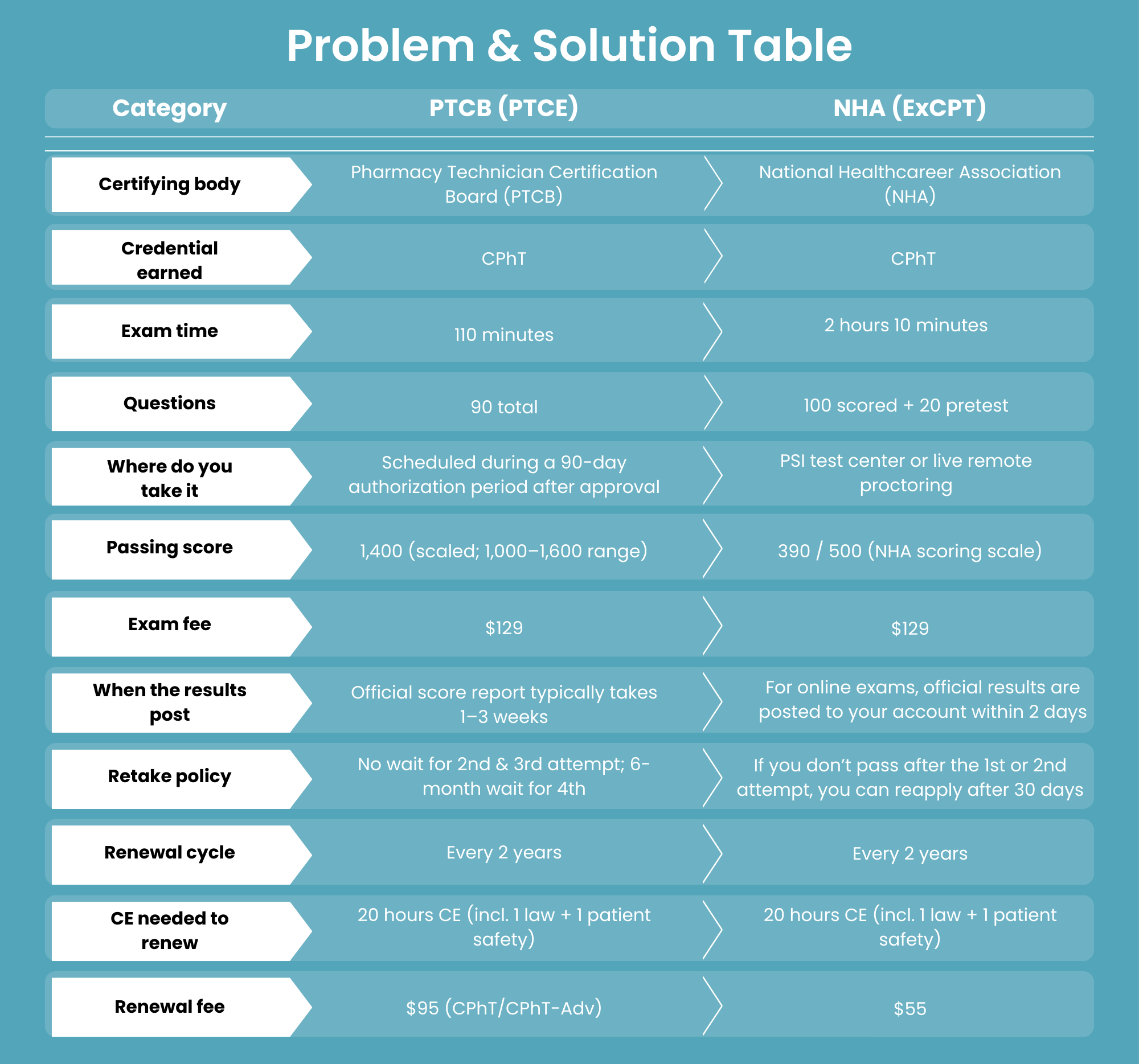 Quick tip: If your state board or employer calls out one exam by name (common in some job listings), take that one. If they accept either, use the sections below (eligibility + logistics + retakes + renewal) to pick the best fit.
What is the PTCB?
The Pharmacy Technician Certification Board (PTCB) is one of the main organizations that certifies pharmacy technicians in the United States. Their certification exam is called the PTCE (Pharmacy Technician Certification Exam).
Passing the PTCE allows you to earn the CPhT (Certified Pharmacy Technician) credential, which many employers and state boards recognize as proof that you have the knowledge required to safely support pharmacists and handle pharmacy operations.
The PTCE exam tests knowledge across four core areas:
- Medications
- Federal Requirements
- Patient Safety and Quality Assurance
- Order Entry and Processing
As of the current PTCE content outline, the exam includes four weighted domains: Medications, Federal Requirements, Patient Safety and Quality Assurance, and Order Entry and Processing. The PTCE includes 90 multiple-choice questions, but only 80 are scored; the remaining 10 are unscored pilot questions.
To become certified through PTCB, applicants must generally:
- Live in the United States or its territories
- Meet education or work-experience eligibility requirements
- Comply with PTCB certification policies
- Pass the PTCE exam
Once you pass the exam, you can use the CPhT designation and maintain your certification through continuing education and periodic renewal.
And if you want to see some examples of the questions you might be asked, you can take a PTCB practice test for free.
What is the ExCPT?
The ExCPT (Exam for the Certification of Pharmacy Technicians) is the pharmacy technician certification exam offered by the National Healthcareer Association (NHA).
Like the PTCE, passing the ExCPT allows you to earn the CPhT credential, meaning both exams ultimately certify you as a Certified Pharmacy Technician.
The ExCPT exam includes 120 total questions, made up of 100 scored questions and 20 pretest questions. The exam focuses heavily on real-world pharmacy technician duties, including laws, drug therapy, dispensing, medication safety, and quality assurance. NHA provides official exam test plans for its certification exams, including the ExCPT.
However, the two organizations differ slightly in focus. While the PTCB specializes specifically in pharmacy technician certification, the NHA offers certifications across multiple healthcare roles, including medical assistants, phlebotomists, and pharmacy technicians.
The ExCPT exam evaluates knowledge in several key areas of pharmacy practice, including:
- Overview and Pharmacy Laws
- Drugs and Drug Therapy
- Dispensing Process
- Medication Safety and Quality Assurance
To qualify for the ExCPT exam, applicants typically need:
- A high school diploma or equivalent
- Either completion of a pharmacy technician training program or
- Work experience in a pharmacy setting
Once candidates pass the exam, they can use the CPhT credential and maintain certification through continuing education and renewal.
Eligibility Requirements: PTCB vs ExCPT
Before deciding which certification to pursue, it’s important to make sure you meet the eligibility requirements for the exam.
Both PTCB and NHA require candidates to have basic education credentials and pharmacy-related training or experience, but the pathways can differ slightly.
PTCB (PTCE) Eligibility
To apply for the PTCE, candidates must generally:
- Reside in the United States or its territories
- Complete a PTCB-recognized education/training program or have equivalent pharmacy technician work experience
- Complete at least 500 hours of equivalent work experience if using the work-experience pathway
- Disclose criminal or State Board of Pharmacy actions
- Comply with PTCB certification policies
- Pass the PTCE exam
These requirements are designed to ensure candidates have the foundational knowledge needed to work safely in a pharmacy environment.
To qualify for the ExCPT, candidates generally need a high school diploma or equivalent and must meet either a training pathway or a work-experience pathway. The work-experience pathway usually requires at least 1 year of pharmacy-related work experience and 1,200 supervised pharmacy-related hours within the last 3 years.
ExCPT (NHA) Eligibility
To take the ExCPT exam, applicants must meet one of the following pathways:
Option 1: Training pathway
- High school diploma (or equivalent)
- Completion of a pharmacy technician training program within the past 5 years
Option 2: Work experience pathway
- High school diploma (or equivalent)
- At least 1 year of pharmacy work experience
- A minimum of 1,200 hours of supervised pharmacy-related work within the last 3 years
This flexibility makes the ExCPT a common option for candidates who gained their knowledge primarily through on-the-job experience.
Quick Tip For Choosing Based On Eligibility
If you have already completed a formal pharmacy technician training program, you will likely qualify for both exams.
However, if your experience comes mainly from working in a pharmacy, reviewing each organization’s eligibility pathways can help you decide which exam fits your situation best.
Exam Format & Content: What You’ll Be Tested On
Both the PTCE (PTCB) and the ExCPT (NHA) are computer-based certification exams that test the knowledge pharmacy technicians need to safely assist pharmacists and manage pharmacy operations.
While the exams are similar in overall structure, there are some differences in timing, question counts, and scoring methods.
PTCE Exam Format (PTCB)
The Pharmacy Technician Certification Exam (PTCE) includes:
- 90 total questions
- 110-minute time limit
- Computer-based testing
- Multiple-choice format
Scores are reported on a scaled score system ranging from 1,000 to 1,600, and a score of 1,400 or higher is required to pass.
The exam is designed to evaluate knowledge in four primary domains:
- Medications: Drug names, classifications, and therapeutic uses
- Federal Requirements: Pharmacy law and regulatory compliance
- Patient Safety & Quality Assurance: Medication safety and error prevention
- Order Entry & Processing: Prescription processing and pharmacy workflow
ExCPT Exam Format (NHA)
The ExCPT (Exam for the Certification of Pharmacy Technicians) follows a similar structure but includes a slightly different question count and time limit.
The exam typically includes:
- 120 total questions
- 2 hours and 10 minutes to complete the exam
- Computer-based testing
- Multiple-choice questions
Scores are reported on a 500-point scale, with 390 required to pass.
The ExCPT exam measures knowledge across several pharmacy practice areas:
- Overview and Pharmacy Laws
- Drugs and Drug Therapy
- Dispensing Process
- Medication Safety and Quality Assurance
What Candidates Should Expect When Preparing
Even though the exam names are different, the topics tested are largely the same. Both exams focus on the practical knowledge pharmacy technicians use every day in a pharmacy setting.
Candidates should expect questions involving:
- Medication names and classifications
- Pharmacy calculations
- Prescription processing steps
- Federal pharmacy laws and regulations
- Medication safety and error prevention
Because of these similarities, many study resources and preparation strategies can work for either exam.
PTCB vs ExCPT Exam Content Breakdown
|
PTCE content area |
What it covers |
|
Medications |
Drug names, classifications, indications, interactions, storage, and safety |
|
Federal Requirements |
Federal pharmacy laws, controlled substances, and restricted drug programs |
|
Patient Safety and Quality Assurance |
Error prevention, high-alert medications, quality assurance, safety procedures |
|
Order Entry and Processing |
Prescription intake, calculations, billing basics, product selection, labeling |
|
ExCPT content area |
What it covers |
|
Role, Responsibilities, and General Duties |
Technician duties, communication, professionalism |
|
Laws |
Pharmacy laws, controlled substances, and regulatory requirements |
|
Drugs and Drug Therapy |
Medication classes, dosage forms, and routes of administration |
|
Dispensing Process |
Prescription processing, calculations, packaging, labeling |
|
Medication and Patient Safety / Quality Assurance |
Error prevention, safety checks, quality assurance |
Cost & Scheduling: How to Register for the Exam
Once you decide which certification to pursue, the next step is applying for the exam and scheduling your test date. The process is fairly straightforward for both PTCB and NHA certifications.
PTCE (PTCB) Exam Cost And Scheduling
The PTCE exam fee is $129.
To schedule the exam, candidates must first create an account on the PTCB website and submit an application. After your application is approved, you will receive an Authorization to Test (ATT) email.
This authorization allows you to schedule your exam during a 90-day testing window.
Once approved, you can:
- Choose a testing center location
- Select an available test date and time
- Complete your exam during the authorized testing period
After finishing the exam, your official score report is typically available within a few weeks through your PTCB account.
ExCPT (NHA) Exam Cost And Scheduling
The ExCPT exam fee is also $129.
To take the exam, candidates must first create an NHA account and submit an exam application.
After approval, you can schedule the exam through PSI, the testing provider used by NHA.
Candidates typically have the option to take the exam:
- At a PSI testing center, or
- Through live remote online proctoring
This flexibility allows candidates to choose the testing environment that works best for them.
For many candidates taking the online version, official exam results are available within a few days through the NHA certification portal.
Quick tip for scheduling your exam:
Many candidates schedule their exam 2–6 weeks after beginning their study plan. This provides enough time to review key topics without losing momentum.
If you’re unsure how long to study, taking a practice test early can help identify which areas need the most preparation.
Retake Policies: What Happens If You Don’t Pass?
Not passing the exam on your first attempt can be frustrating, but it’s important to know that many candidates pass on a later attempt. Both PTCB and NHA allow retakes, though their policies are slightly different.
Understanding these rules can help you plan your study schedule and reduce stress if your first attempt doesn’t go as expected.
PTCE (PTCB) Retake Rules
PTCB allows multiple exam attempts, but waiting periods apply after certain attempts.
If you fail the PTCE, you must wait until your official score report is available before reapplying. There is no additional waiting period for the second and third attempts, but candidates must wait six months before the fourth attempt. After four failed attempts, PTCB may require proof of acceptable preparation before allowing another attempt.
Each retake requires submitting a new application and paying the exam fee.
This structure allows candidates to quickly attempt the exam again while their study material is still fresh.
ExCPT (NHA) Retake Rules
The NHA also allows candidates to retake the ExCPT exam, but the waiting periods are slightly different.
If you do not pass the exam:
- You must wait 30 days before retaking the exam after the first or second attempt
- If you do not pass after the third attempt, you must wait one year before attempting the exam again
Like the PTCE, each retake requires a new application and exam fee.
What To Do If You Fail The Exam
If you don’t pass on your first try, the best approach is to treat the result as feedback on which areas need improvement.
- Review your score report. Identify the domains where you lost the most points.
- Rebuild your weak areas. Focus on medications, pharmacy law, calculations, and prescription processing.
- Take timed practice tests. Do not only review notes; practice under exam-like timing.
- Schedule your retake strategically. Retake when your practice scores are consistently improving, not just because the waiting period is over.
Many pharmacy technicians pass on their second attempt after targeted preparation.
PTCB vs ExCPT: Which is harder?
Neither exam is automatically easier for everyone. The PTCE may feel more challenging if you struggle with medication names, drug classifications, federal requirements, or pharmacy calculations. The ExCPT may feel more practical for candidates with hands-on pharmacy experience because it places strong emphasis on dispensing workflow, safety, and technician duties.
The better question is not “Which exam is easier?” but “Which exam matches my background and requirements?”
Do states accept both PTCB and ExCPT?
Many states and employers accept national pharmacy technician certification, but requirements vary. PTCB says its certification is accepted by regulatory bodies and employers in all 50 states, the District of Columbia, Guam, and Puerto Rico. PTCB also notes that certification, registration, licensure, and renewal requirements vary by state and can change.
Before choosing an exam, check your state board of pharmacy and your target employer’s requirements.
Renewal & Continuing Education: Maintaining Your Certification
Passing the PTCE or ExCPT earns you the Certified Pharmacy Technician (CPhT) credential, but certification must be renewed periodically to remain active.
Both PTCB and NHA require pharmacy technicians to complete continuing education (CE) and renew their certification every two years.
|
Renewal requirement |
PTCB CPhT |
NHA ExCPT CPhT |
|
Renewal cycle |
Every 2 years |
Every 2 years |
|
CE hours |
20 hours |
20 hours |
|
Pharmacy law CE |
1 hour |
1 hour |
|
Patient safety CE |
1 hour |
1 hour |
|
Renewal fee |
Add current PTCB fee |
Add the current NHA fee |
PTCB Renewal Requirements
PTCB certification must be renewed every two years.
To renew your certification, you must:
- Complete 20 hours of continuing education (CE)
- Include 1 hour of pharmacy law
- Include 1 hour of patient safety
- Pay the renewal fee
These continuing education requirements help ensure pharmacy technicians stay up to date with changing regulations, medications, and safety practices.
ExCPT (NHA) Renewal Requirements
The NHA CPhT certification also requires renewal every two years.
To maintain certification, technicians must:
- Complete 20 hours of continuing education
- Include 1 hour of pharmacy law
- Include 1 hour of patient safety
- Pay a $55 renewal fee
Continuing education activities may include approved training courses, professional development programs, or pharmacy-related educational activities.
Why Continuing Education Matters
Pharmacy practice evolves constantly as new medications, safety guidelines, and regulations are introduced.
Continuing education helps ensure pharmacy technicians maintain the knowledge needed to:
- Support pharmacists effectively
- Prevent medication errors
- Follow current pharmacy laws and safety standards
Maintaining certification through continuing education helps technicians remain competitive in the job market and compliant with employer or state requirements.
So which should you choose?
Choose PTCB/PTCE if:
- Your state board or employer specifically asks for PTCB certification
- You want the certification most commonly referenced in pharmacy technician job postings
- You prefer a pharmacy-technician-specific certifying organization
- You are comfortable taking the exam at a Pearson testing center
Choose ExCPT/NHA if:
- Your school or employer uses NHA certification
- Your state/employer accepts either certification
- You prefer NHA’s PSI or live remote proctoring options
- Your eligibility pathway fits NHA’s training or work-experience requirements
30-Second Decision Check
- Does your state board require one exam? Take that one.
- Does your employer or job posting name one exam? Take that one.
- Are both accepted? Choose based on eligibility, testing location, retake rules, and your preferred study path.
- Still unsure? PTCB is often the more commonly referenced pharmacy-technician-specific route, while ExCPT may be convenient if your school or employer already uses NHA.
Conclusion
Both PTCB and ExCPT can help you become a Certified Pharmacy Technician, but the right exam depends on your state rules, employer expectations, eligibility pathway, and testing preference. If one exam is required by your state board, school, or employer, choose that exam first. If both are accepted, compare the exam format, scheduling options, retake rules, and renewal requirements before deciding.
If you decide to take the PTCE, PTCB Hero can help you prepare with exam-style practice questions, focused review, and a structured study plan.
FAQs on PTCB vs ExCPT
1. Is PTCB better than ExCPT?
PTCB is not automatically better than ExCPT. PTCB may be better if your employer or state board specifically asks for it, while ExCPT may be better if your school or employer uses NHA or if you prefer NHA’s testing options.
2. Do both PTCB and ExCPT make you a CPhT?
Yes. Passing either the PTCE through PTCB or the ExCPT through NHA can lead to the Certified Pharmacy Technician credential.
3. Is ExCPT easier than PTCB?
Not necessarily. The easier exam depends on your background, study habits, and familiarity with the exam content.
4. Can I take the PTCB exam online?
For the PTCE, PTCB currently states that the exam is administered in person at Pearson VUE testing centers.
5. Can I take the ExCPT online?
NHA states that the ExCPT can be taken at a PSI location or through live remote proctoring.
Related Reads
Can You Become A Pharmacy Tech Without A High School Diploma?
