

Most CNAs wear clean scrubs, closed-toe slip-resistant shoes, an ID badge, and minimal jewelry. However, there is no single national CNA dress code. The exact rules depend on your employer, CNA school, or clinical site. Some facilities assign scrub colors by role, while others allow more flexibility. Before buying scrubs or shoes, always check your employee handbook, orientation packet, or clinical dress-code policy.
In healthcare, dress codes are not only about appearance. A proper CNA uniform helps patients identify staff, supports infection-control practices, reduces safety risks, and creates a professional care environment.
CNAs spend much of their shift walking, bending, lifting, transferring patients, and assisting with personal care. That is why most facilities require clean, comfortable scrubs and supportive shoes that allow safe movement throughout the shift.
If you’re considering a career in nursing, learning how to dress and present yourself is crucial. You should master the right dressing style from the time you go for your CNA interview to the first day on the job. This article covers the various kinds of dress codes applicable to CNAs.
Quick CNA Dress Code Checklist
| Dress code item | Usually acceptable | Usually not acceptable |
| Scrubs | Clean, wrinkle-free scrubs in the approved color | Ripped, stained, tight, or wrong-color scrubs |
| Shoes | Closed-toe, closed-heel, slip-resistant shoes | Sandals, high heels, open-back clogs, dirty shoes |
| Hair | Clean and secured away from the face | Loose hair that interferes with patient care |
| Nails | Short, clean, natural nails | Long nails, acrylics, extensions, chipped polish |
| Jewelry | ID badge, small studs, simple watch, if allowed | Dangling earrings, bracelets, bulky rings |
| Fragrance | No scent or very mild scent | Strong perfume, cologne, and smoke odor |
| PPE | Gloves, gowns, masks, or eye protection when required | Using scrubs as a substitute for PPE |
CNA Clinical Dress Code for Students
CNA students may have stricter dress-code rules during clinicals than they will have at work. A CNA program or clinical site may require a specific scrub color, name badge, closed-toe shoes, short nails, tied-back hair, and limited jewelry. Students should read their program handbook before buying scrubs or shoes because clinical sites may send students home for dress-code violations.
What to Wear During Your CNA Interview
To start your career in the nursing field, the first step is to clear the CNA job interview. Wearing suitable attire for your interview day is just as crucial as other educational and training preparations. Although nurses are usually seen wearing scrubs in medical organizations, that should not be your interview attire.
Never forget that the first impression is a lasting one!
Here are some top dressing tips to help you leave your best first impression.
Dress According to the Company’s Dress Code

It is always wise to go to an interview after thorough background research about the company. Once your interview is scheduled, you should know if the company has any dress code before attending it. Some companies will prefer that you come wearing a specific dress code.
Before your interview, review the job posting, confirmation email, or employer website for dress instructions. If the interview includes a facility tour, skills demonstration, or shadowing experience, ask whether you should bring or wear scrubs.
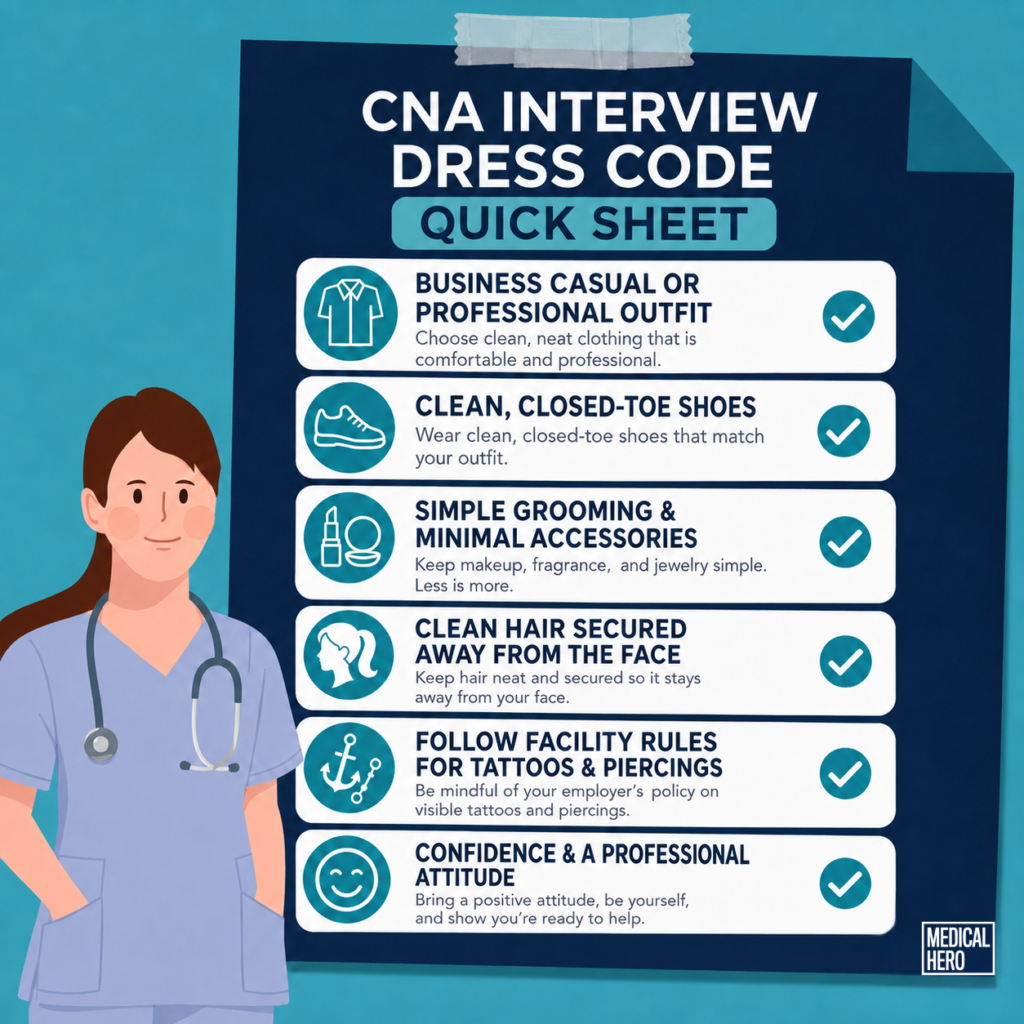
In most companies, the standard dress code is formal attire. For most CNA interviews, business casual or professional clothing is appropriate. Good options include slacks, a blouse, a button-down shirt, a sweater, a blazer, or a knee-length skirt or dress. Choose clean, modest, comfortable clothing that allows you to look professional without being distracting.
Accessories and Makeup
But one thing to keep in mind is whether to keep a beard or not. For accessories, you can wear a nice watch to level up your look.
For women, remember to keep your makeup and accessories minimal. Keep makeup, fragrance, and accessories simple and professional. Avoid strong perfume or cologne, heavy makeup, dangling jewelry, or anything that may distract from the interview.
As for accessories, a watch will be your best match. You may pair up minimal jewelry like a small pair of earrings and a plain pendant.
Facial hair, visible tattoos, and piercings are handled differently by each employer. For an interview, choose a neat, professional appearance and avoid jewelry or accessories that may be considered unsafe in patient-care settings. If a dress or grooming rule conflicts with religious, cultural, or medical needs, ask the employer or HR team about accommodation options.
The Perfect Shoe to Match
For the interview, wear clean, closed-toe shoes that match your outfit. Avoid sandals, high heels, flashy shoes, or shoes that look worn out. If you are asked to tour the facility or shadow a CNA, comfortable closed-toe shoes are the safest choice.
Best Shoes for CNAs at Work
CNAs are on their feet for long shifts, so shoes should be comfortable, supportive, and safe. Most facilities prefer closed-toe, closed-heel, slip-resistant shoes that are easy to clean. Avoid sandals, high heels, open-back clogs, and shoes made from absorbent fabric unless your employer allows them.
Styling your Hair
To complete your look, the perfect hairstyle is of utmost importance.
Hair should be clean, neat, and secured away from the face during patient care. Long hair is usually tied back in a ponytail, bun, braid, or another secure style. Avoid large clips, loose accessories, or hairstyles that may fall into your face while assisting patients.
To complete your whole look, wear your most confident smile.
With all these guidelines, you may curate the most professional CNA interview needs.
Once you are hired or assigned to a clinical site, your employer or CNA program will provide specific dress-code instructions. Always follow those instructions first, even if they differ from general CNA dress-code advice.
Fingernails
You are normally not allowed to have nail extensions, it might hamper your work and raise safety concerns. It has been observed that long fake nails are healthcare acquired infection risks.
It’s recommended to keep nails short and clean for hygienic purposes.
CNAs should keep nails short, clean, and natural unless their facility allows otherwise. Long nails, acrylic nails, gel extensions, and chipped nail polish can interfere with hand hygiene, glove use, and patient safety. Because CNAs frequently wash their hands, sanitize, wear gloves, and assist with personal care, nail rules are usually stricter than in non-healthcare jobs.
CNA Dress Code at Work
Traditional white nursing uniforms are much less common today. Most CNAs now wear scrubs because they are practical, comfortable, and easier to maintain during long shifts.
Many hospitals and long-term care facilities assign scrub colors by role or department. For example, CNAs, LPNs, RNs, therapists, and other staff may wear different colors so patients and coworkers can identify them more easily.
Today, the most widely used CNA dress code is scrubs and shoes. It’s important not to go to work with body piercings and tattoos. You are normally not allowed to have nail extensions, it might hamper your work and raise safety concerns.
Patients have their views on the dress codes of medical staff, too. A study done in Geisinger Medical Center, a hospital in central northeast Pennsylvania, in 2014 conducted an evidence-based practice (EBP) to bring changes in their dress code. EBP is the combination of judicious use of the best nursing clinical practice and patient values to make the best decision.
Patients often use uniforms, badges, and scrub colors to identify healthcare workers. Clear dress-code policies can help patients recognize who is caring for them and may improve confidence in the care team.
CNA Dress Code at Work
Scrubs are usually considered work attire, not personal protective equipment. OSHA defines PPE as specialized clothing or equipment worn to protect against a hazard. General work clothes, including uniforms, pants, shirts, and blouses, are not considered PPE unless they are intended to protect against a specific hazard.
CNAs should still use task-specific PPE, such as gloves, gowns, masks, eye protection, or respirators, when required by the task, isolation precautions, or facility policy.
Are Scrubs Considered PPE?
CNAs should wear clean scrubs for each shift and follow their employer’s laundering policy. If scrubs are visibly contaminated with blood, body fluids, or other potentially infectious material, follow facility procedures instead of taking them home casually. CDC guidance recognizes that healthcare laundry may include uniforms and scrub suits, and contaminated textiles can contain microorganisms from blood, stool, urine, vomit, and other body substances.
If your facility provides scrubs or requires hospital-laundered uniforms, follow those rules exactly.
What CNAs Should Not Wear at Work
In addition to proper dress code and what to wear. You must also know what not to wear in a medical setting. Facility policies vary, but CNAs are usually expected to avoid anything that creates a safety risk, interferes with infection control, or appears unprofessional in a patient-care setting.
Many facilities restrict dangling earrings, facial piercings, tongue rings, large hoops, and jewelry that could be pulled by a patient or interfere with PPE. Small stud earrings may be allowed, depending on the employer’s policy. Due to the nature of the work, keep rings and wrist accessories minimal.
Visible tattoo policies vary by facility. Some employers allow tattoos unless they are offensive or inappropriate, while others require visible tattoos to be covered with clothing or an approved sleeve. Follow your employee handbook or ask your supervisor before your first shift.
Avoid ripped, stained, tight, see-through, or ill-fitting uniforms. Pant legs should not drag on the floor because they can create a safety and hygiene issue. Avoid bare-midriff tops, low-cut tops, short skirts, hoodies, or jackets unless your facility allows them.
What to Bring on Your First CNA Shift
Along with wearing the correct uniform, CNAs should bring any items required by their employer or clinical site. Common first-shift items include an ID badge, a watch with a second hand if allowed, pens, a small notebook, comfortable shoes, and any required documentation. Avoid bringing unnecessary valuables or accessories to the unit.
Wrapping up
A CNA dress code is about more than looking professional. Clean scrubs, safe shoes, short nails, secured hair, minimal jewelry, and proper PPE all help support patient safety and workplace standards. Since every employer and clinical site may have different requirements, always check your handbook or ask your supervisor before buying uniforms or accessories.
Emphasizing the dress code may seem trivial, but it can create a long-lasting impression from your CNA certification exam to your career. If you are preparing for CNA certification, you can also build confidence by practicing with our free CNA practice test before exam day.
Remember, the most important thing you can wear is your smile and confidence!
Frequently Asked Questions
What is the most common color for scrubs?
Blue is one of the most common scrub colors in healthcare, but CNA scrub colors vary by workplace. Some facilities assign specific colors to CNAs, nurses, therapists, and other staff so patients can identify care team members more easily.
Can CNAs wear whatever scrubs they want?
Usually, no. CNAs should wear the scrub color, style, and fit required by their employer, CNA program, or clinical site. Always check the dress code policy before buying new scrubs.
Can CNAs wear their hair down?
CNAs with short hair may be allowed to wear it down if it stays away from the face. Long hair is usually tied back to prevent it from interfering with patient care, hand hygiene, or PPE.
Can CNAs accessorize their uniforms?
Minimal accessories may be allowed, such as a watch, small stud earrings, or a simple ring. Avoid dangling earrings, bracelets, necklaces, or bulky jewelry because they may create safety or infection-control concerns.
Do CNAs need to follow hygiene and grooming standards?
Yes. CNAs are expected to maintain good hygiene and grooming because they work closely with patients. Clean uniforms, short nails, secured hair, and proper hand hygiene help reduce infection risks and support a professional care environment.
What should CNAs do if they’re unsure about the dress code at their workplace?
CNAs should check the employee handbook, orientation materials, CNA program handbook, or clinical-site policy. If anything is unclear, ask a supervisor, instructor, or HR before your first shift.
