

Diagnostic medical sonographers, often called ultrasound technologists, use high-frequency sound waves to create images that help physicians diagnose and monitor medical conditions. Sonography can be a strong healthcare career path because many roles require an associate degree or postsecondary certificate, and the field has faster-than-average job growth.
According to the BLS, diagnostic medical sonographers had a 2024 median annual wage of $89,340, with the highest 10% earning more than $123,170. Employment is projected to grow 13% from 2024 to 2034, with about 5,800 openings per year.
In this guide, we’ll compare some of the highest-paying sonography specialties, what each role does, which certifications may help, and how to choose the best specialty for your career goals.
Where Do Sonographers Earn the Most?
Salary is not determined by specialty alone. Work setting can make a major difference. According to BLS, diagnostic medical sonographers working in outpatient care centers had a median annual wage of $123,610 in May 2024, compared with $90,070 in hospitals, $89,450 in physician offices, and $83,200 in medical and diagnostic laboratories.
This means a sonographer in a high-paying setting may earn more than another sonographer in a traditionally “high-paying” specialty but lower-paying workplace.
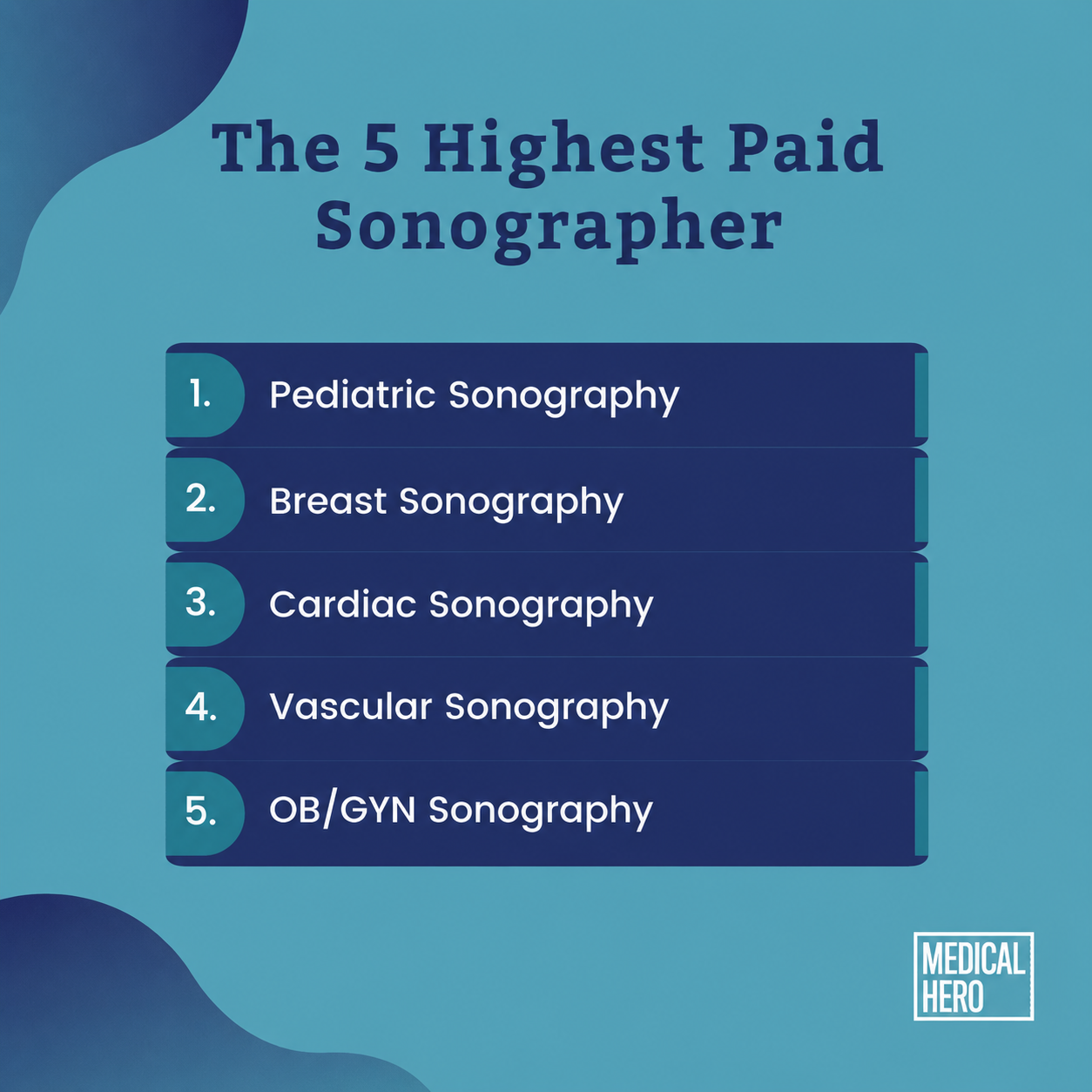
The 5 Highest Paid Sonographer
According to the U.S. Bureau of Labor Statistics, diagnostic medical sonographers earned a median annual wage of $89,340 in May 2024, or $42.95 per hour. The lowest 10% earned less than $64,760, while the highest 10% earned more than $123,170.
The career outlook is also strong. Employment of diagnostic medical sonographers is projected to grow 13% from 2024 to 2034, which is much faster than the average for all occupations. BLS projects about 5,800 openings per year, on average, during that period.
|
Salary / career factor |
Current reliable data |
|
Median annual wage for diagnostic medical sonographers |
$89,340 |
|
Median hourly wage |
$42.95 |
|
Lowest 10% |
Less than $64,760 |
|
Highest 10% |
More than $123,170 |
|
Projected job growth, 2024–2034 |
13% |
|
Average annual openings |
About 5,800 |
BLS currently lists these figures in its Diagnostic Medical Sonographers Occupational Outlook Handbook profile.
PEDIATRIC SONOGRAPHY
Pediatric sonography is a specialized area of diagnostic medical sonography focused on imaging infants, children, and adolescents. Pediatric sonographers use ultrasound equipment to help physicians evaluate medical conditions affecting young patients, including issues related to premature birth, birth defects, abdominal concerns, soft tissue conditions, and other pediatric health problems.
This specialty requires strong technical skills as well as patience and communication skills, because pediatric sonographers often work with children who may be anxious, uncomfortable, or unable to stay still during the exam. They may also communicate with parents, pediatricians, and other healthcare professionals throughout the imaging process.
Common responsibilities of a pediatric sonographer include:
- Preparing children and parents for ultrasound procedures
- Positioning infants or children safely for imaging
- Capturing clear diagnostic images
- Reviewing images for quality and coverage
- Maintaining ultrasound equipment and exam rooms
- Recording findings and sharing image summaries with physicians
Pediatric sonography can be a strong specialty choice for sonographers who enjoy working with children and want to develop advanced imaging skills. Sonographers interested in this field may pursue the RDMS Pediatric Sonography credential, which requires passing the ARDMS SPI exam and the Pediatric Sonography specialty exam.
Pediatric sonographer salaries vary by employer, location, experience, certification, and work setting. BLS reports that diagnostic medical sonographers overall earned a median annual wage of $89,340 in May 2024, while the highest 10% earned more than $123,170.
BREAST SONOGRAPHY
Breast sonography creates digital images of the breast’s interior using sound waves and their echoes. It can reveal some breast abnormalities that may be more difficult to notice on mammograms, such as fluid-filled cysts. Women who have dense breast tissue, which can make it challenging to spot suspicious areas on mammograms, may find sonograms to be very beneficial. It can be also used to gain a closer look at a questionable spot that was seen on a mammogram.
Breast sonography is one of the specialties offered by diagnostic medical sonographers. Common responsibilities and duties of a breast sonographer are the following:
- Continuously checks on the health of the patient, and reports or reacts to any changes in status as needed.
- Performs breast ultrasound exams, captures images of breast tissue, and assists physicians by providing imaging that may help evaluate lumps, cysts, tumors, or suspicious findings from other exams.
- Helps the doctor execute interventional procedures, such as fine-needle aspirations, localizations, and biopsies that are guided by ultrasound and stereotactic imaging.
- chooses the proper imaging parameters and exposure variables.
- Takes part in monitoring adherence to Mammography Quality Standards Act (MQSA) rules.
Breast sonographer salaries vary by location, experience, employer, and whether the role is combined with mammography or biopsy-assistance responsibilities. Instead of relying on one unsupported national figure, compare current BLS sonographer wage data with recent job postings in your state.
CARDIAC SONOGRAPHY/ECHOCARDIOGRAPHY
Cardiovascular sonographers also referred to as echocardiographers, are medical experts with specialized training in using imaging technologies to assist physicians with diagnosing patients’ heart conditions. The images produced by echocardiography are used by doctors to identify cardiac conditions and suggest treatments.
Cardiac sonographers, also known as echocardiographers, perform echocardiograms to help physicians evaluate heart structure and function. This specialty may appeal to sonographers who are interested in heart disease, blood flow, valve function, and advanced imaging. Many cardiac sonographers pursue the RDCS credential through ARDMS, which requires SPI plus a cardiac specialty exam.
Cardiovascular sonography is one of the many specialties that diagnostic medical sonographers can specialize in. The following are some of the responsibilities of a cardiac sonographer:
- Collecting important patient information from echocardiography testing.
- Monitoring blood flow, valve performance, and chamber size to assess the general health of the heart.
- Assisting doctors to identify patients with cardiac problems.
- Assisting with administrative tasks, such as appointment scheduling or equipment maintenance.
- Recording patient information and test results precisely.
Cardiac sonographer salaries can vary significantly by state, employer, credential, and experience. For a stronger article, avoid presenting one fixed salary unless it is tied to a clearly cited source and year.
VASCULAR SONOGRAPHY
Vascular sonographers use ultrasound technology to examine blood vessels and blood flow throughout the body. Their exams may help detect blocked arteries, blood clots, circulation problems, or other vascular conditions. This specialty can be a good fit for sonographers who enjoy detailed imaging, anatomy, and working closely with physicians who diagnose vascular disease.
Diagnostic medical sonographers can specialize in a wide range of specialties, including vascular sonography. A vascular sonographer is responsible for the following tasks:
- Ensuring that the facilities, labs, and technology utilized for sonographic examinations are clean, disinfected, and maintained.
- Keeping track of patient medical records, and updating them as needed.
- Operating all plethysmography and ultrasound apparatus.
- Examining patients using sonography, and creating vascular pictures.
- Interacting with patients prior to, during, and after exams to explain the process, help them through it, and then go over the results.
- Continually looking into the latest advancements in diagnostic methods and sonography equipment.
Vascular sonography careers can be personally and professionally fulfilling. Vascular sonographer salaries depend on experience, certification, location, and employer type. Sonographers interested in this specialty may consider the RVT credential, which ARDMS awards after candidates meet requirements and pass the SPI and Vascular Technology exams.
OB/GYN SONOGRAPHY
OB/GYN sonography involves doing ultrasounds on female patients’ pelvic areas and developing fetuses. These sonographers capture clear images of the internal female organs. OB/GYN sonographers might interact intimately with clients, as pregnant moms are worried about the health of their unborn children. As a result, they must maintain decorum and demonstrate sincere concern.
Sonographers can specialize in a variety of fields, including OB/GYN sonography. The following are some of the responsibilities of an OB/GYN sonographer:
- Review the medical history of the patients.
- Educating patients on specific medical procedures.
- Maintain a close watch on the fetus’s weight.
- Identify whether additional testing is required.
OB/GYN sonographers need strong communication skills because they often work with patients during emotionally significant moments, including pregnancy scans, fertility evaluations, and follow-up imaging. They must be able to explain the exam process clearly while leaving diagnosis and medical interpretation to the physician.
OB/GYN sonographer salaries vary by employer, location, experience, and whether the role includes high-risk pregnancy or maternal-fetal medicine imaging. Sonographers who want to specialize in this area may pursue the RDMS credential with the OB/GYN specialty exam.
Certifications That Can Help Sonographers Specialize
Certification can help sonographers qualify for specialized roles and may improve job competitiveness. ARDMS credentials usually require candidates to pass the Sonography Principles & Instrumentation exam, also called the SPI exam, plus a specialty exam.
Common ARDMS credential paths include:
- RDMS: Abdomen, Breast, Fetal Echocardiography, OB/GYN, or Pediatric Sonography
- RDCS: Adult Echocardiography, Fetal Echocardiography, or Pediatric Echocardiography
- RVT: Vascular Technology
- RMSKS: Musculoskeletal Sonography
ARDMS requires candidates to pass the SPI exam and the applicable specialty exam within five years to earn credentials such as RDMS, RDCS, RVT, or RMSKS.
How to Increase Your Salary as a Sonographer
Add a practical list:
- Earn ARDMS credentials related to your specialty.
- Gain experience in high-demand areas such as cardiac, vascular, OB/GYN, breast, pediatric, or musculoskeletal sonography.
- Consider outpatient care centers, specialized clinics, or travel sonography roles.
- Build strong patient care and communication skills.
- Learn advanced imaging procedures or assist with ultrasound-guided procedures.
- Stay current with continuing education and equipment changes.
How to Choose a Sonography Program
When comparing sonography programs, look for accreditation, clinical training opportunities, specialty options, lab facilities, board exam preparation, tuition costs, location, and job placement support. Students should also check whether the program is listed by CAAHEP, which states that its search tool includes programs that are currently accredited or hold a Letter of Review.
Wrapping Up
Sonography can be a rewarding career for people who want to work in healthcare, use imaging technology, and interact directly with patients. While salary varies by specialty, location, employer, and credentials, diagnostic medical sonography offers strong national earning potential and faster-than-average projected job growth.
If you are planning to become a sonographer, start by choosing an accredited program, learning which specialty interests you most, and preparing for certification exams such as the ARDMS SPI exam. To begin your exam preparation, try our free SPI practice test and review the topics you need to strengthen before test day.
Frequently Asked Questions (FAQs)
WHAT TO LOOK FOR IN A SONOGRAPHY PROGRAM?
It’s important to choose a sonography program and school that best meet your academic goals when you’re looking for one. The following are some of the things to look into before enrolling in a sonography school:
- Accreditation
- Training in Specialities
- Tuition Fees
- Location
- Training Facilities
- Career Assistance
WHAT ARE THE TYPES OF SONOGRAPHERS?
Sonographers can grow in their careers by gaining experience, further certificates, and the necessary credentials. You can think about the several types of sonographers listed below:
- Diagnostic medical sonographer
- Diagnostic cardiovascular sonographer
- Abdominal sonographer
- Obstetric sonographer
- Musculoskeletal sonographer
- Breast sonographer
- Neurosonology sonographer
WHAT ARE THE SKILLS REQUIRED FOR SONOGRAPHERS?
- Interpersonal skills
- Communication
- Attention to detail
- Technical competency
- Physical strength
DO SONOGRAPHERS NEED CERTIFICATION?
Certification requirements vary by employer and state, but many employers prefer or require professional certification. ARDMS credentials typically require the SPI exam plus a specialty exam, depending on whether the candidate is pursuing RDMS, RDCS, RVT, or RMSKS.
Related Reads
How to Become a Veterinary Sonographer: A Comprehensive Guide
